
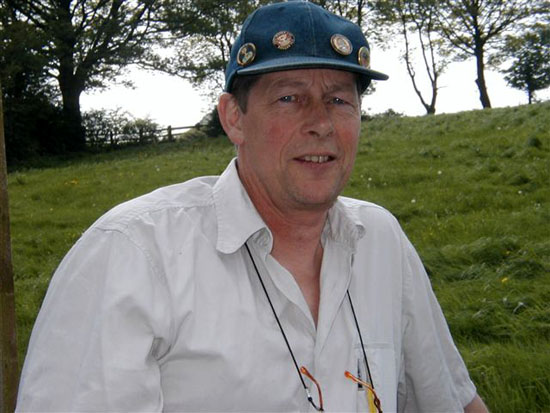
2004 World Cup Champion Peter Handy
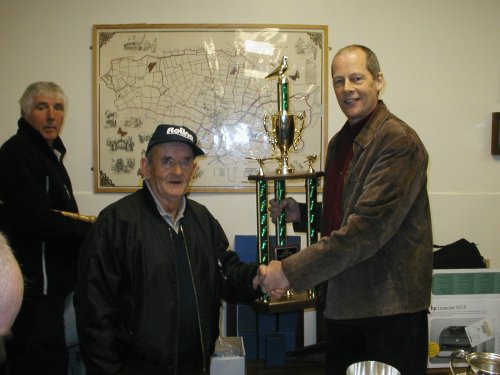
Winning the World Cup Fly, the Major trophy in the roller calendar was such an exhilarating never to be forgotten experience, and I was walking on air for days, then Steve Clayton asked me for an article for the journal, and I came back to earth with a bump when I realised that I was expected to say something intelligent. Ive got news for you all, winning the World Cup doesnt increase your brain-power, just swells your head a little, neither does it turn you into some kind of roller guru, so Ill just try and talk about how I first got into the hobby, and see how it goes from there.
Unlike many pigeon fanciers, pigeons were not in my blood, that is to say that I started with pigeons relatively late in life. I was around 30 years old when my wife Linda, and I moved into a country cottage. We both fancied keeping some sort of small livestock around the place because we were both fond of animals, and it would be a bit of an interest for Linda while I was at work. Linda wanted a duck! I wasnt too keen on the noise and muck that a duck would bring, so we went to a local market and bought a few Old English Game bantams which were lovely, we both enjoyed keeping them, and the eggs were much better than supermarket eggs. However after some time I got the showing and breeding bug, so I got a breeding cock, and suddenly they were my birds. Linda was not too fond of being attacked by the bantam cock every time she went in the pen to collect the eggs. Before we got our little bantam cock we went to a show in Birmingham looking for stock. There were very few entries in the poultry section, but there were hundreds of pigeons of all varieties. We decided to take a pair home, I had already got a couple of cross-bred pigeons in an old out-house at the time, but I had read about tumblers and rollers, and I was intrigued. After looking at all the options we decided on a pair of Birmingham Rollers, because they were beautiful pigeons, not freaky looking like some varieties, and I wanted to see them perform. I lost the hen, but broke out the cock, and when he started single flipping around the yard I was hooked. I went around the local shows acquiring a few more birds, all pure show stock, but some of them could ball up and roll as good as anything seen in competition today. As a present, Linda bought me 3 pair from a Mr Walter Lench, who was leaving the hobby. Walter was breeding for dual-purpose birds, but mostly showed his rollers. Walter had an ear condition that affected his balance when he looked up, and he was, I think, getting disenchanted with the way the show guys were pushing for bigger pigeons. I met him at a show one day and he took a red check cock out of a pen that the judge had put down as too small. It was small to medium by todays standards; it was a beautiful roller, nicely proportioned, good feather quality with a nice wedge shaped body that wouldnt be out of place in any flying loft.
The judge says it is to small he said, but then told me it was a great looking roller that he wouldnt mind having in his own loft. Walter told the judge he had a loft full of identical birds at home, but the winning birds were not the ideal type for a flying pigeon. When I joined the All England Roller Club, I was advised by some of the leading lights of the day, to get rid of my birds, as Walters birds were not true rollers, but by this time I was into my second breeding season, and I had grown fond of the family of birds I was working with. Walter had flown in a few competitions in the Midland club, but I suspect his birds had never been in flying condition. He once told me that when they came to judge his birds, he had to take 10 birds out of the kit because he always flew 30 together, but the competition was for a kit of 20.
I guess you could say that they were not exactly primed for competition. When I flew my first fly, with hardly any knowledge of training a kit for competition, the birds scored well, and I came in 5th with only 9 rollers in a 20-bird kit, the rest were single flippers or straight flyers. To this day I still have the tiny scrap of paper that was the MRPC score sheet. I got 5-6-5-6-6-8-6-7, 20 for kitting, and 16 for merit but Im not sure what that was out-of.
The judge didnt realise it, but those 8s were the equivalent to almost full turns for the rollers in that kit. I had been around and watched the performance of the top fanciers, and was educating myself to recognise good style. Some of those leading lights were below me on that first score sheet, and although I knew even then, that the best rollers dont always win, I also knew that my rollers were as good in the roll as most, only lacking a bit of frequency and the bigger breaks, which I hoped would come when I put more rollers together. There was a Canadian visitor called Monty on that fly, he didnt know the source of my birds, and said some complimentary things about the style of my rollers. When I asked judge what he thought of the kit, I was told that he thought that they had performed well, considering where my birds came from.
Walter started his family of rollers with 3 pair bought from Wilf Portman in 1967, and I was told they had been kept pure. I still fly some of that family today.
After stupidly getting out of the hobby in the early 1990s I was unable to get back enough decent birds of my old family to make a good start again, and so I am now also working with other birds based around Shackleton, Lenihan, Barrett, Harris, and other strains crossed in. I am currently trying to work a Harris outcross into my old family, they have a touch already, having used a cock I bought from Ollie, for a single outcross around 1987.
I havent deliberately gone for crosses, but got what I could, where I could, and was grateful to be flying rollers again. If money was not an issue I would probably have gone for one of the long established families of rollers and bought the best available.
I cant say that I have a mentor in the hobby, I learned from reading journals, and from Bill Pensoms book, but mostly from my many mistakes.
However, in 1997 I visited John Lenihans home near Bristol.
John hadnt any stock he could sell me, but I had a great weekend, stopping overnight with John and his wife June. In the evening we sat in Johns lounge talking about this and that, (rollers may have come into the conversation somewhere along the line) when John asked, How old are you Peter?
I said I was 49, and John asked, How long ago did you start in rollers? I said it was around 13 years, and John looked at me and said, Dont you think its about time you started to do a bit of something with them?
I was a bit taken aback by Johns candour, but not surprised, because one of Johns great qualities is telling it how he sees it, and I admire him greatly for it.
I said something to the effect that he was probably right.
The next day before I left, John handed me a cock bird saying, This bird may do you a bit of good.
That bird, ( SWRC-101-1996) a blue checker badge, flew in this years World Cup team, and is the sire and grandsire to many of my best birds, Thank you John, you are a true gentleman of the hobby.
But John was right, I had been in rollers long enough to have gained some measure of success, but I had always been one of those content to stay in the middle of the table, never winning, never coming last. I think that chance remark from John gave me the kick up the rear end that I needed. I realised that if I wanted to win, which I admit hadnt been all that high on my list of priorities; I needed to change my mindset.
I had to put the main thrust of my energy into where it would be most effective. I realised that to increase my chances of success, I had had to set myself a target, and shoot for it.
Some fanciers are Master breeders or strain makers, others do everything well, I think that to succeed, we have to know our strengths, and try to work with them, while trying to improve our weaker aspects.
My favourite aspect of keeping rollers is in flying a kit to try and get it to fly to its highest potential.
I realised, that because Ive never had the appetite for raising large numbers of rollers in the middle of winter, coupled with the late developing nature of the birds I was working with, that young bird flying wasnt the way to go, so I decided to concentrate on flying an old bird team.
I had never done particularly well in the All England flies which fall at the end of the season, and had never been in a local or regional club apart for a short spell in the Midland club, until I joined the NWRC. I generally got plenty of good flys in the earlier part of the year from April through July, when Id no competitions in England to fly in, so I decided to concentrate my efforts on the World Cup fly, which is flown a little earlier in the year. It may sound like I was aiming a bit high, but I knew I had a better chance of winning the World Cup than winning an All England young bird fly.
I didnt qualify at my first attempt in 1999 but scored well, and came in 5th in the qualifier. I looked at the score sheet from that fly to check my facts, and the judges comments were, Good kit of rollers, worked well in the wind, maybe a pointer for the future there from Paul Lee?
Having a goal and working towards it seemed to be producing results.
This made me more determined for 2000, which seemed to be a special year for many people, being millennium year, and I had high hopes. I had the team just right for the qualifying round, and the birds were as good as I have ever seen. I qualified with Englands top score, well clear of my nearest competitor.
We have an old saying that goes, After the Lord Mayors parade comes the muck cart. The final was a letdown, partly due to the misty/rainy weather, (thats my excuse anyway) and I came in around 5th in Europe, after the competition was split in two, due to Montys tragic accident.
I didnt really know Monty, having met him just once, all those years before, and I had never met Heine, but news of that crash took the wind out of my sails, and I couldnt have cared less if I had come last.
I kind of lost the plot a little in 2001, and the birds took a back seat in 2002 when Linda had two further strokes, but someone much smarter and optimistic than me once said, there is no such thing as failure, just temporary setbacks.
2003 Was more like it, I had them on song again, and won the English qualifier in first place almost 60 points clear of the second placed kit. In the final, the kit put in a solid performance, but not close enough to what they were capable of, and they finished a creditable 4th. I was almost over the moon! So near, yet so far away!
It was clearly time to go for broke, and through the winter of 2003/2004, I flew every bird I had, including stock birds, and spent all my spare time working with the kit, trying different birds when one or other wasnt kitting or rolling as well as it should.
By this time I wasnt experimenting with prepping them, because they seemed relatively easy to manage in that respect. Getting a good fly out of them became easier as the kit chemistry came together. Getting a special fly out of any kit is never easy, but if you get a team together that seems to naturally work well together, then sometimes an average fly will win the day, and I have seen many flies lost through too much manipulation. So I concentrated on selecting the 20 birds that worked best together. I was fortunate that the Peregrines and Hawks left me alone to keep flying the team, only having one bird, a mealy hen, taken around December.
I scraped into the final, gaining second place in the qualifying round. I heard rumours that Dennis was a strict judge, and there were no high scores, and was concerned that maybe my kit was below what Dennis considered as acceptable.
I neednt have worried; Denis scored my team about the same as I would have done, and was no different in his standards from most English Judges.
I still cant believe the final, flown in winds that would break a kite string, but when the kit eventually clawed their way back to Kingsley Holt, they clung together well, and broke well, ending up 56 points clear of the next kit, in what turned out to be a comparatively low scoring competition.
Concentrating on my Old Bird team has improved my results in other
Competitions.
Prior to 1999 I had never won a flying trophy, but that year I gained a 3rd place in the English National fly. In 2002 I came 4th, and 3rdagain in 2003, also having a bird picked out as best roller in that competition. I also won the North West Roller Club Old bird fly, in 02, 03, and 04 against some good opposition.
I would like to congratulate Peter Lynham for his second placing. I am reliably informed that he would have taken first place if not for a mob of racers breaking them up. Well-done Pete, and hard luck! I would like to thank all the World Cup Team for all their hard work, and Dennis Burke for completing the mammoth task of judging all those kits. A special thanks must go to our regional director Paul Lee who has done a sterling job, running the World cup and our National flys for so long, I dont know how we will manage without him when he retires from the job.
Many, many thanks, to all those who have wished me well, and offered their congratulations and support.
When I announced that I wouldnt leave home to judge next years fly, I was overwhelmed by some of the offers of help that I received from around the world, and from friends and family in England. My decision not to judge was made even before I knew the final result, but the generosity of spirit I have felt from the hobby, often from guys Ive never met, has been an experience that has made me feel very humble, and I dont mind admitting, just a bit emotional, thanks, you guys.
It is this camaraderie that makes Roller flying such a wonderful sport.
My ambitions for the future, apart from repeating this years success, are to one day fly a kit comprised entirely of top class rollers that break together,
Score a full turn in competition, (wouldnt we all just love to do that),
also one day Id like to win an English National Fly, and an All England flying Trophy of any sort. Maybe one day I will win the novices trophy, we can all dream.
First and last, I would like to thank my wife Linda for her support through the years.
She was as pleased as me when we got the final result. Her constant disappointment is that she cannot put on the lunches and teas for the flies so often, like she used to enjoy doing.
P.S Over the years we have owned a horse, dogs, aviary birds, poultry, rabbits, fish, (tropical and freshwater), cavies, mice, gerbils, hamsters, and pigeons, but she never did get that duck. Please! dont anyone remind her.
Editors Note : Pete won the old bird fly in the All England Roller Club fly. And also won the secretary's merit shield for most quality points and one of his rollers came third in the rose bowl competition.
| Back |